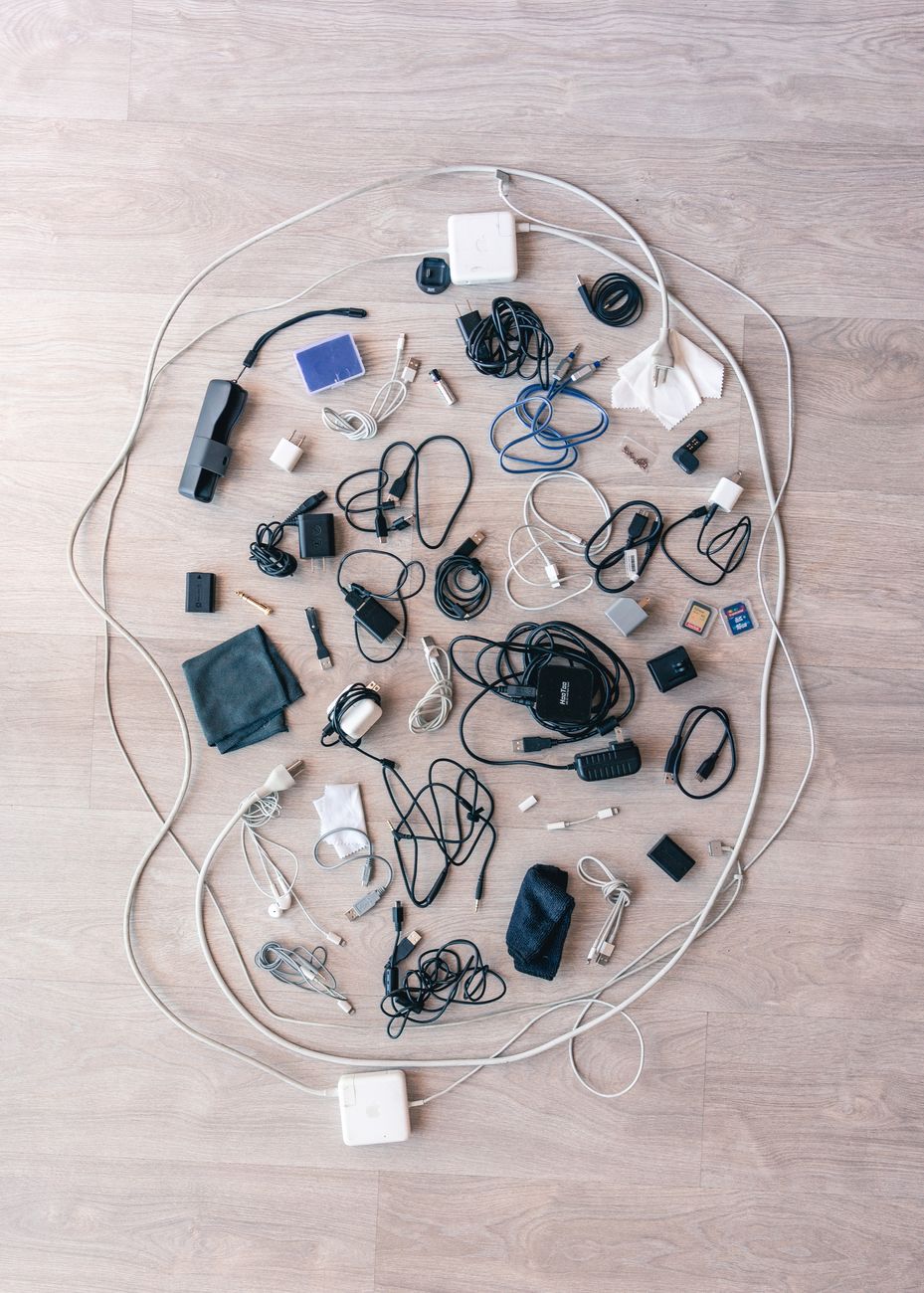
One of the most confusing parts of packing for a Royal Caribbean cruise is figuring out what you can bring to charge your devices.
Search Amazon for cruise chargers and you’ll find products described as “cruise approved,” “cruise essentials” or “made for cruise ships.” But those words on an Amazon listing do not determine what Royal Caribbean allows onboard.
Royal Caribbean has its own prohibited-items policy, and that is what I use when deciding what goes in our suitcase.
The good news is that you can absolutely bring chargers for your phones, watches, tablets and other devices. The important part is understanding the difference between a charger and something Royal Caribbean classifies as an extension cord, power strip or multi-plug outlet.
Here’s how I look at it.
What does Royal Caribbean currently say about chargers?
Royal Caribbean’s current prohibited-items policy specifically says that electrical equipment including extension cords, power strips and multi-plug outlets is prohibited.
The policy then provides an exception for:
“Device and USB chargers marked with a recognized U.S. or European conformity certification.”
That distinction matters. Royal Caribbean has not created a general exception saying that every electrical product with a certification mark is permitted. Extension cords, power strips and multi-plug outlets remain in the prohibited category.
Does “cruise approved” on Amazon mean it is allowed?
No. “Cruise approved” is not an official Royal Caribbean product certification.
A seller can use words such as “cruise,” “cruise essential,” “cruise ship travel” or similar language in a product title. That does not override Royal Caribbean’s written policy.
This is why I don’t decide whether to pack an electrical item based on what the Amazon title says.
I look at what the product actually does.
That is probably the most important takeaway from this entire guide:
Ignore the marketing name and inspect the actual ports and function of the product.
What is the difference between a USB charger and a multi-plug outlet?
This is where I think much of the confusion happens.
A simple USB charging block plugs into the wall and gives you USB charging ports for your devices.
It isn’t creating additional traditional electrical outlets.
Compare that with a product that plugs into one wall outlet and then gives you one or more additional AC electrical outlets, perhaps alongside some USB ports.
The fact that the product also has USB ports doesn’t erase the other function.
Royal Caribbean separately prohibits multi-plug outlets and power strips while providing an exception for qualifying device and USB chargers.
Because of that wording, I personally stick with straightforward USB charging blocks rather than trying to push into a gray area with something that also adds AC outlets.
Does a certification mark make any electrical item okay?
No. This is another part of the policy that can easily be misunderstood.
Royal Caribbean says the device and USB chargers covered by its exception must carry a recognized U.S. or European conformity certification.
That does not mean:
certification mark = everything is permitted.
The type of electrical product still matters.
For example, putting a recognized certification mark on an extension cord would not turn the extension cord into a USB charger. Royal Caribbean separately lists extension cords as prohibited.
I use the same logic when evaluating power strips and multi-plug devices.
An Amazon listing that looks confusing at first glance
This is exactly why I made a video about this topic.
I found a travel adapter from a major brand that could easily look like a good cruise option when you’re scrolling through Amazon.
The product includes:
- one AC electrical outlet
- two USB-C ports
- two USB-A ports
Someone could look at the USB ports and think, “Royal Caribbean allows USB chargers, so this should be fine.”
That’s not how I approach it.
Because the product also provides an additional AC electrical outlet, I would not treat it as the same thing as a straightforward USB-only charging block or assume that the USB-charger exception automatically covers it.
When I have a simple option that clearly fits the written policy, I would rather pack that than spend embarkation day wondering how Security will interpret something more complicated.
What about power strips advertised specifically for cruises?
This is an even easier decision.
You’ll find plenty of Amazon products described as things like:
“Cruise Essentials Power Strip”
Some even emphasize that they don’t have surge protection.
That wording can be misleading because Royal Caribbean’s current rule is not simply:
No surge protectors.
Royal Caribbean expressly lists power strips among its prohibited electrical items. It also separately lists extension cords and multi-plug outlets.
So I would not buy a power strip for Royal Caribbean just because an Amazon seller calls it a cruise essential or advertises it as non-surge.
What do I bring instead of a power strip?
I use a compact multiport USB charging block.
That’s particularly useful for us because I don’t plan our charging needs based on the number of people in the room.
I count devices.
Three people might bring:
- three phones
- two or three watches
- wireless headphones
- a tablet
- a power bank
- other rechargeable travel items
Suddenly three travelers can easily have six, seven, or more things that need charging.
Instead of trying to create more AC outlets, I use USB charging ports more efficiently.
How many chargers do you need in a Royal Caribbean cabin?
Before buying anything, make a quick list of everything your group will charge.
You don’t necessarily need enough ports to charge every item simultaneously.
For example, you may charge phones overnight, recharge a power bank at a different time and charge headphones only occasionally.
But knowing your device count before you travel is much better than discovering once you’re onboard that three people are competing for the same charging spot.
I also recommend checking the outlet setup on your specific Royal Caribbean ship.
Newer ships may have charging options that older Royal Caribbean cabins don’t have, so there isn’t one outlet configuration that applies to every ship in the fleet.
Can you use a European outlet in a Royal Caribbean cabin?
Depending on the ship and stateroom, you may have access to a European-style electrical outlet in addition to U.S.-style outlets.
A simple plug adapter can potentially make that otherwise-unused outlet useful.
But there is an important distinction:
A plug adapter does not convert voltage.
It only changes the physical plug configuration.
Before connecting a device, check the electrical specifications of that particular device and make sure it is designed to operate on the voltage being supplied.
I would never assume an expensive hair tool or other electrical appliance can use a European outlet simply because I can physically make the plug fit.
What about portable power banks?
Portable chargers, also called power banks, are one of the electronics I find genuinely useful when cruising.
Royal Caribbean’s own current packing guidance recommends bringing a portable charger and makes a point of distinguishing a power bank from a prohibited multi-outlet power bar.
I usually recharge our power bank in the cabin overnight and take it with me the next day.
That’s useful at places like CocoCay or on shore excursions because we use our phones for photos, videos, messages, apps and sometimes transportation once we’re back in port.
Royal Caribbean also recommends portable chargers among useful travel electronics in its current travel guidance.
If you’re flying to your cruise, remember that airlines have their own rules for lithium batteries and power banks, so check your airline’s requirements as well.
“But I’ve brought my power strip onboard before.”
You will hear this frequently in cruise groups and comment sections. Someone will say:
“I take mine every time.”
Or:
“Security has never stopped me.”
That may be completely true. But there is an important distinction between:
an item making it through security
and
an item being permitted under Royal Caribbean’s written policy.
Those aren’t necessarily the same thing.
Royal Caribbean’s current policy lists power strips, extension cords and multi-plug outlets as prohibited.
Personally, I don’t want to start a vacation knowingly packing something that conflicts with the published rules and hoping it gets through screening.
I’d rather set myself up for success before I leave home.
What happens if Royal Caribbean doesn’t allow an electrical item?
Royal Caribbean explains that prohibited or restricted items can be removed or confiscated as part of its security process. Some items can involve special handling rather than simply traveling to your stateroom with you.
That’s another reason I prefer to resolve the question before embarkation.
The first day of my cruise is not when I want to discover that the electrical product I bought specifically for the trip isn’t something Royal Caribbean wants onboard.
What I personally look for before packing a charger
My quick test is straightforward.
First, I look at the actual product, not the Amazon title.
Then I ask:
Does this simply charge my devices through USB?
If yes, I check the product for the conformity certification Royal Caribbean requires.
Does it add traditional AC electrical outlets?
That’s where I stop treating it like a simple USB charger and look much more carefully at the prohibited multi-plug and power-strip language.
Is there an extension cord attached?
I leave it home.
Is it actually a power strip?
I leave it home.
Does the listing say “cruise approved”?
That doesn’t change any of the answers above.
My Cruise Approved Electronics list
I’ve spent a lot of time looking at Royal Caribbean’s written policy because charging questions come up constantly.
I created a Cruise Approved Electronics list in my Amazon storefront with the types of charging products I am comfortable taking based on Royal Caribbean’s current written rules.
That name does not mean Amazon, the manufacturer or Royal Caribbean has issued some special “cruise approved” certification for the products.
It means I’ve reviewed what I’m recommending against Royal Caribbean’s published policy and deliberately avoided things like extension cords, power strips and multi-plug outlets.
Royal Caribbean Security ultimately controls what is permitted onboard, and policies can change, so I always recommend checking Royal Caribbean’s current rules before your own sailing.
Royal Caribbean Charger and Electronics FAQs
Can I bring a USB charger on Royal Caribbean?
Yes. Royal Caribbean currently provides an exception for device and USB chargers marked with a recognized U.S. or European conformity certification.
Can a USB charger have several USB ports?
Yes. Royal Caribbean’s rule refers to USB chargers rather than imposing a one-USB-port limit. A multiport USB charging block is the type of solution I personally use because it allows several devices to charge without adding AC outlets. Best practice is to bring a charging block with 4 ports or less.
Can I bring a power strip on Royal Caribbean if it doesn’t have surge protection?
No. Royal Caribbean’s current policy lists power strips as prohibited. The wording is not limited to surge-protected power strips.
Can I bring an extension cord on Royal Caribbean?
No. Royal Caribbean lists extension cords as prohibited electrical items.
If you need an extension cord for medical equipment such as a CPAP machine, contact Royal Caribbean’s Guest Special Needs/Access team rather than bringing your own extension cord.
Can I bring a multi-plug outlet on Royal Caribbean?
No. Royal Caribbean specifically includes multi-plug outlets among its prohibited electrical equipment.
What about a charger that has USB ports and an AC outlet?
No. This is a multi-plug. Royal Caribbean’s written exception specifically covers device and USB chargers, while its prohibited list separately includes multi-plug outlets and power strips.
Does a UL, ETL, CE or other mark automatically make a charger allowed?
A conformity mark by itself does not override the type of product.
Royal Caribbean says permitted device and USB chargers must have a recognized U.S. or European conformity certification. That is a condition of the charger exception. It is not a blanket exception for every prohibited electrical product carrying a certification mark.
Is “cruise approved” an official Royal Caribbean certification?
No. Treat “cruise approved” on retail listings as marketing language rather than an official approval from Royal Caribbean.
Always compare the actual product with Royal Caribbean’s current prohibited-items policy.
Can I bring a European plug adapter on Royal Caribbean?
A simple plug adapter can be useful when your cabin has a compatible European outlet and the device you are connecting is designed for the voltage provided.
Remember that an adapter changes the plug configuration. It does not convert voltage.
Can I bring a power bank on Royal Caribbean?
Royal Caribbean’s own packing guidance recommends portable chargers or power banks and specifically distinguishes them from prohibited multi-outlet power bars.
If you’re flying, check your airline’s rules for traveling with lithium-battery power banks.
How many electrical outlets are in a Royal Caribbean cabin?
It varies by ship and cabin design.
That is why I recommend checking the outlet arrangement for your actual ship rather than relying on a general Royal Caribbean answer. Newer and older ships can have different configurations and USB availability.
Do all Royal Caribbean cabins have USB ports?
No single USB setup applies to every ship and cabin across the fleet. Check the outlet configuration for the specific ship you’re sailing.
How do I charge several devices without a power strip?
Start by counting devices rather than travelers. Then use available cabin outlets efficiently with qualifying multiport USB charging blocks and, where appropriate, compatible adapters. A portable power bank also gives you another way to keep phones charged away from the cabin.
Can I bring my charger because someone in a Facebook group said theirs was allowed?
No. Other cruisers’ experiences can be helpful, but I wouldn’t use one person’s security experience as a substitute for the current written policy.
Something getting onboard previously doesn’t necessarily establish that Royal Caribbean permits that category of product.
What if Amazon says the product is specifically designed for cruise ships?
I would still check the product yourself.
Look for additional AC outlets, an extension cord, or a power-strip design and compare those features with Royal Caribbean’s current prohibited-items policy.
The product’s function matters more than the words in the product title.
Final takeaway
You don’t have to make charging complicated. Before our cruises, I:
Count our devices, check our ship’s outlet arrangement, pack straightforward USB charging equipment that fits Royal Caribbean’s written rules, charge a power bank for days away from the cabin and leave extension cords, power strips and multi-plug outlets at home.
Most importantly, I don’t rely on the words “cruise approved” in an Amazon title.
I look at what the product actually does.
If you want to see the electronics I’ve reviewed for our own cruises, my Cruise Approved Electronics list is linked in my Amazon storefront.






Leave a Reply