If you have never taken a cruise, the pricing can be confusing.
You see an advertised cruise fare, but then you hear cruisers talking about drink packages, gratuities, specialty restaurants, Wi-Fi, shore excursions, spa treatments and private-island upgrades.
It is reasonable to wonder:
What exactly does the cruise fare pay for and are cruises really just a money pit once all the extras are added?
The answer is more nuanced than either extreme.
A cruise can be a relatively inclusive vacation if you stick primarily with what is included in your fare.
It can also become a very expensive vacation if you add enough upgrades.
The better question isn’t simply, “How much does the cruise cost?”
It is:
How much will the version of this cruise that I actually want to take cost?
That is the number worth comparing with a hotel, resort, theme-park vacation or other trip.
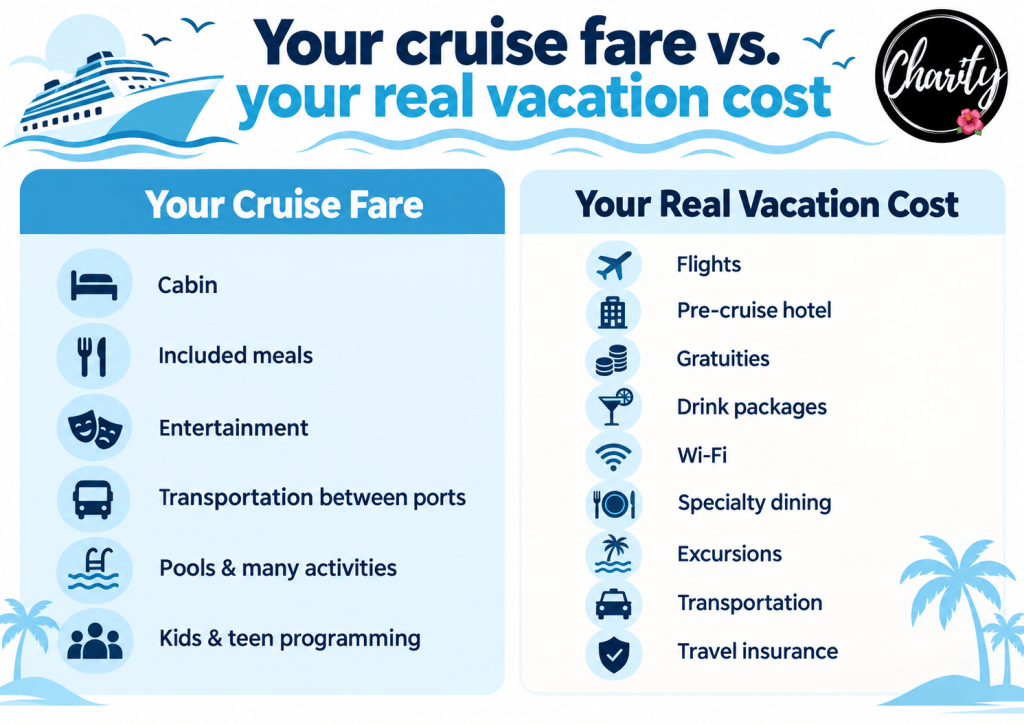
What Is Included in a Cruise Fare?
Your basic cruise fare generally covers much more than just transportation.
Depending on the cruise line and ship, your fare will usually include:
Your stateroom
Whether you choose an interior room, ocean-view room, balcony or suite, your accommodations are included in the price you book.
Of course, moving into a higher cabin category increases the original fare.
Transportation between ports
Your ship is essentially your transportation and hotel combined.
You unpack once, and the ship takes you from destination to destination.
A substantial amount of food
Cruise ships typically include several dining options at no additional charge.
On Royal Caribbean, for example, that can include venues such as:
- Main Dining Room
- Windjammer buffet
- Café Promenade or similar cafés
- Sorrento’s on many ships
- Park Café on select ships
- Solarium Bistro on select ships
- Various snack and casual venues depending on the ship
You can absolutely take a cruise without purchasing specialty dining.
Entertainment
Many of the things people would normally buy tickets for on land are included with the cruise fare.
Depending on the ship, that can include:
- Production shows
- Aqua shows
- Ice skating shows
- Live music
- Comedy
- Game shows
- Trivia
- Parades
- Karaoke
- Pool activities
Some activities require reservations on certain Royal Caribbean ships, but the reservation itself is typically free.
Pools and many activities
Most standard pools, hot tubs and many onboard activities are included.
Again, ships vary considerably, so some premium attractions may cost extra.
Kids and teen programming
Many cruise lines include supervised youth programming as part of the cruise fare, although some late-night programs, nursery services or special activities may have additional charges.
What Usually Costs Extra on a Cruise?
This is where cruise spending can climb quickly.
None of these categories is necessarily a problem on its own.
The issue is that purchasing several of them together can dramatically change the total cost of the vacation.
Alcohol and drink packages
Standard cruise fares usually include some basic beverages.
Premium coffees, soda, bottled water, cocktails, beer and wine may cost extra depending on your cruise line and package.
A beverage package can easily become one of the largest expenses beyond the cruise fare.
And this is exactly why I don’t recommend asking only:
“Is the drink package worth it?”
Ask:
“Is it worth it for how I actually drink on vacation?”
Those are not the same question.
Specialty Dining
Cruise ships increasingly offer restaurants that aren’t included in the standard fare.
You might find:
- Steakhouses
- Seafood restaurants
- Italian restaurants
- Hibachi
- Chef’s-table experiences
- Brunches
- Premium tasting menus
You don’t need any of these to eat well on a cruise.
But if food is an important part of your vacation, you may decide they’re worth paying for.
That’s an upgrade, not necessarily a hidden fee.
Wi-Fi
If you want to stay connected at sea, internet access will commonly cost extra unless it is included in your fare, suite category, loyalty benefits or another package.
For families with several devices, Wi-Fi can add a meaningful amount to the trip.
This is one of the costs people often forget when comparing cruise prices.
Shore Excursions
When you arrive in port, you can often walk around or explore independently without buying anything from the cruise line.
But organized excursions can add hundreds of dollars to the vacation—especially for a family.
Examples include:
- Snorkeling
- Beach clubs
- Island tours
- Zip lines
- Boat trips
- Wildlife tours
- Cultural experiences
- Transportation to attractions
For Alaska and Europe in particular, excursions can become a major portion of the total vacation budget.
Gratuities
Cruise gratuities should be included in your budget from the beginning.
They are easy to overlook because they may not appear prominently in the advertised cruise fare.
Depending on the cruise line, gratuities may be prepaid, added automatically during the cruise or handled according to that line’s policies.
Private-Island Extras
Cruise-line private destinations can be a particularly interesting example of optional spending.
You may be able to have a perfectly enjoyable day using the included beaches, pools and food.
But cruise lines may also sell:
- Beach clubs
- Cabanas
- Water parks
- Premium seating
- Specialty dining
- Equipment rentals
- Experiences and excursions
You can spend almost nothing—or several hundred dollars per person—at essentially the same destination.
The Spa, Shopping and Other Extras
Other optional spending can include:
- Spa services
- Salon appointments
- Fitness classes
- Photos
- Souvenirs
- Onboard shopping
- Arcade games
- Adult arcade spending
- Specialty activities
- Premium experiences
Again, none of those is required to take the cruise.
The Real Problem With Comparing Cruise Prices
Suppose you see a cruise advertised for $699 per person.
It is tempting to mentally categorize that as:
“A $699 vacation.”
It probably isn’t.
At minimum, you should think about:
- Cruise fare
- Taxes and fees
- Gratuities
- Transportation to the port
- Flights if needed
- Airport parking
- Hotel before the cruise
- Transportation between airport, hotel and port
- Wi-Fi
- Drinks
- Specialty dining
- Excursions
- Travel insurance
- Spending money
You may not need every one of these.
But you should account for the ones you realistically expect to buy.
A Better Way to Budget for a Cruise
Instead of starting with the advertised fare, build your vacation from the bottom up.
Step 1: Price the cruise itself
Include:
- Cruise fare
- Taxes and fees
- Cabin category you actually want
Don’t price an interior cabin if you know you will ultimately book a balcony.
Step 2: Add required or highly likely costs
For your family, that might include:
- Gratuities
- Airfare
- Pre-cruise hotel
- Transportation
- Travel insurance
Step 3: Add the extras you genuinely value
Maybe that is:
- Deluxe beverage package
- Refreshment package
- Wi-Fi
- Two specialty dinners
- One excursion
Don’t pretend you’re going to skip all of those if history tells you you’re going to buy them.
Step 4: Compare that total with another vacation
Now compare apples to apples.
If a cruise costs your family $5,000 all-in, compare it with what a comparable week would cost elsewhere after adding:
- Hotel
- Rental car
- Meals
- Entertainment
- Parking
- Activities
- Resort fees
- Transportation
That comparison is much more useful than comparing a cruise fare with a hotel room rate.
Can You Cruise Without Buying Extras?
Absolutely.
A person could board a cruise ship and spend very little beyond the cruise fare and required charges.
You could:
- Eat in included restaurants
- Drink included beverages
- Attend included entertainment
- Use the pools
- Participate in included activities
- Explore ports independently
- Skip specialty dining
- Skip drink packages
- Skip Wi-Fi
For some cruisers, that is exactly how they travel.
For others, the upgrades are part of the reason they enjoy cruising.
Neither approach is wrong.
When Does a Cruise Become a Money Pit?
A cruise starts feeling like a money pit when you purchase upgrades without deciding in advance whether they actually improve your vacation.
The spending can become incremental:
It’s only another $75.
Then:
It’s only another $120.
Then:
We might as well buy the package.
By the time the cruise arrives, you may have added thousands of dollars to the original booking.
Cruise lines are very good at selling optional upgrades.
That’s their business.
Your job as the traveler is deciding which of those upgrades actually matter to you.
Are Cruise Extras Hidden Fees?
Usually, I wouldn’t describe optional packages like specialty dining or drink packages as hidden fees.
They’re upsells.
That distinction matters.
However, cruise pricing can absolutely be difficult for first-time cruisers to understand because the advertised fare doesn’t necessarily represent the total trip cost.
So I think cruise lines and travel websites deserve some scrutiny when a very low headline price makes a vacation appear substantially cheaper than most travelers will ultimately pay.
The solution as a consumer is to price the entire trip, not just the fare.
Are Cruises Still a Good Value?
Sometimes.
That’s probably the most accurate answer.
Cruising can offer substantial value because your accommodations, transportation between destinations, food and entertainment are bundled together.
But cruising isn’t automatically cheap.
A premium cabin, expensive airfare, drink packages, multiple excursions and specialty dining can turn a cruise into a very expensive vacation.
And sometimes another type of vacation genuinely is the better value.
Don’t force the math to prove cruising is cheaper.
Run the numbers.
My Approach to Cruise Spending
We don’t cruise at the absolute minimum possible cost.
There are things we’re willing to spend money on because they improve the vacation for us.
For example, we may purchase:
- Wi-Fi
- Beverage packages
- Specialty dining
- Excursions we genuinely want to experience
But that doesn’t mean every upgrade is worth buying.
One of the best things you can do before a cruise is decide what matters to your family and spend intentionally on those things.
The Bottom Line
A cruise isn’t inherently a money pit. But it can become one very quickly.
The advertised cruise fare buys you a surprisingly complete vacation.
The cruise line then gives you numerous opportunities to upgrade it.
The smartest question isn’t:
“How cheap is this cruise?”
It’s:
“What will this cruise actually cost once I build the vacation I want?”
Calculate that number first.
Then decide whether the cruise is worth it.
Frequently Asked Questions About the Cost of Cruising
Are cruises really all-inclusive?
Usually not.
Most mainstream cruises include your cabin, many meals, entertainment and numerous onboard activities. Alcohol, specialty dining, Wi-Fi, excursions and other premium experiences commonly cost extra.
Some luxury cruise lines include substantially more.
What is included in a Royal Caribbean cruise fare?
Royal Caribbean fares generally include your stateroom, Main Dining Room and various complimentary dining venues, entertainment, pools and many onboard activities.
The exact included venues and attractions depend on the ship.
What costs extra on Royal Caribbean?
Common additional expenses can include alcoholic beverages, soda packages, specialty dining, Wi-Fi, shore excursions, spa treatments, photos, certain activities and premium private-destination experiences.
Can you go on a cruise without buying a drink package?
Yes.
A drink package is optional.
You can purchase beverages individually or stick with complimentary beverages.
Do you have to pay for food on a cruise?
No.
Mainstream cruise fares include numerous dining options.
Specialty restaurants and certain premium food items may cost extra.
Are cruise shows included?
Most entertainment is included in your cruise fare.
On some larger Royal Caribbean ships, certain shows require reservations, but those reservations are generally free.
Are cruise excursions included?
Usually not.
Shore excursions are typically an additional expense.
You are also generally free to explore ports independently unless local conditions or cruise-line rules dictate otherwise.
Are cruise gratuities included in the advertised price?
Not always.
You should check the specific cruise line and booking because gratuities may be prepaid or added separately.
Include them when calculating your total vacation cost.
How much spending money do you need on a cruise?
There is no universal number.
Someone who skips premium beverages, specialty restaurants, shopping and paid excursions may spend very little onboard.
Another cruiser could spend hundreds or thousands.
Build your budget around what you actually plan to purchase.
Can you spend no money once you’re onboard?
Potentially very little, yes.
If your required charges have already been handled and you use included food, drinks, entertainment and activities, additional onboard spending can be minimal.
That doesn’t mean the overall vacation had no other costs such as transportation or gratuities.
Why do cruises look cheaper than they actually are?
Cruise advertising often emphasizes the base fare.
The total vacation may also include taxes, gratuities, transportation, airfare, hotels, drinks, internet, excursions and other optional purchases.
That’s why the advertised price should be treated as the starting point—not necessarily the final vacation cost.
Is it cheaper to cruise or stay at an all-inclusive resort?
It depends heavily on the destination, airfare, cabin or room category, dates and what you purchase.
When comparing them, include the total vacation cost for both—not just the cruise fare versus the resort nightly rate.
Is a balcony cabin worth the extra money?
That is a personal value decision.
If you spend substantial time in your cabin or enjoy having private outdoor space, you may value it.
If you primarily use your room for sleeping and getting ready, the savings from an interior cabin may matter more.
Are drink packages worth it?
Only if the value of the beverages you would realistically purchase approaches or exceeds the package price—or you value the convenience enough to justify paying more.
Don’t buy one simply because it is advertised as a sale.
Is specialty dining worth paying for?
It can be, but it isn’t necessary.
Your cruise fare already includes food. Specialty dining makes sense when the restaurant or experience is valuable enough to you to justify the additional expense.
What is the biggest hidden cost of a cruise?
For many families, the biggest surprise isn’t one individual charge.
It’s the cumulative cost of multiple categories:
- airfare
- pre-cruise hotel
- gratuities
- beverage packages
- excursions
- Wi-Fi
- specialty dining
Each can seem manageable independently. Together, they can substantially increase the cost of the vacation.
How do I avoid overspending on a cruise?
Set your all-in cruise budget before you start buying extras.
Decide which upgrades matter most and which you are willing to skip.
It is much easier to control cruise spending before departure than while you’re browsing attractive upgrades in the Cruise Planner.
Is cruising worth the money?
It can be.
The answer depends less on whether cruising is objectively “cheap” and more on what you value.
If you enjoy having accommodations, food, entertainment and transportation between destinations packaged together, cruising can offer significant value.
If you aren’t interested in the ship experience or intend to purchase nearly every premium upgrade, another vacation may give you more for the same money.
Want to feel prepared for your cruise?
I pulled the most important Royal Caribbean prep steps into a printable checklist bundle that walks you through what to do before you leave, what to bring, how embarkation works, and what to expect on disembarkation day, so you’re prepared instead of guessing.
Products I Use and Recommend
I keep a list of cruise-approved items I personally use and recommend.



 Charity Bradley 🌺
Leave a comment