Updated August 2026
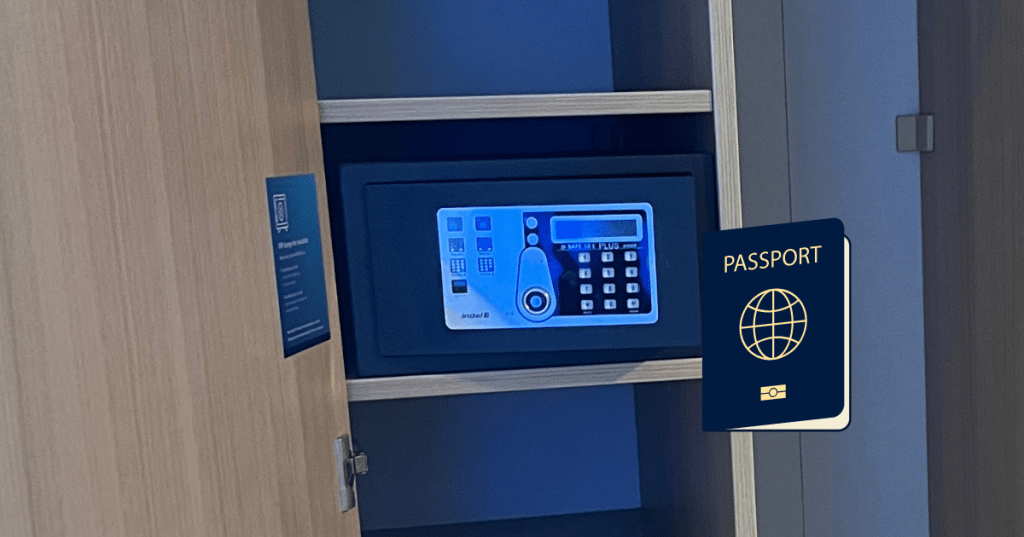
Should you take your passport book with you when you get off a cruise ship in a foreign port, or is it safer locked inside your stateroom safe?
I thought this was a fairly straightforward question until I started seeing how differently cruisers answer it.
Some experienced cruisers insist you should never take your passport book off the ship. They worry about having it lost, stolen or damaged at the beach. Many say they carry a photocopy, a picture of the passport on their phone, or a passport card instead.
Another very common piece of cruise advice is that if you miss the ship, cruise line security will enter your stateroom, open your safe, retrieve your passport book and leave it with the port agent.
After hearing that advice repeatedly, I decided to stop relying on cruise folklore and research what the U.S. State Department and Royal Caribbean actually say.
What I found changed how I handle my passport book in port.
The short answer: I now take my passport book ashore in foreign ports
For most foreign ports, I plan to securely carry my family’s passport books with us when we leave the ship.
There is certainly a risk of a passport being lost, stolen or damaged ashore. I don’t dismiss that concern at all.
But there is another risk to consider: having an emergency in a foreign country while the only document that allows you to fly internationally is locked inside a ship you can no longer reach.
That could happen because of a medical emergency, an accident, an unexpected hospitalization, missing the ship, or another travel disruption.
The U.S. State Department specifically addresses this issue in its guidance for cruise passengers. It strongly recommends that cruise passengers travel with a passport book even when the cruise line does not require one, because an emergency could require you to fly home. It goes further and tells travelers to always carry their passport with them in case of an emergency, including an unexpected medical evacuation or an unplanned change in where the ship docks.
Royal Caribbean’s own published guidance points in the same direction. Royal Caribbean says that while other forms of identification may sometimes be accepted for a cruise, a passport is the best option and that if you have a problem while exploring a foreign port, such as missing the ship, it is best to have a passport with you.
That is very different from the blanket advice I frequently hear that cruisers should “never” take their passport books ashore.
What Royal Caribbean told me when I asked directly
I also contacted Royal Caribbean directly because I wanted to know what they would tell a guest, not just what other cruisers say.
In one Royal Caribbean chat, I asked whether we should take our passport books off the ship with us in Nassau.
After I explained that my concern was what would happen if we had an emergency in the Bahamas and could not get back to the ship, the representative told me:
“It is strongly recommended to take your passport with you when going ashore in a foreign port.”
That answer is consistent with Royal Caribbean’s published FAQ and the State Department’s guidance.
Then I researched another widespread claim.
Will Royal Caribbean get your passport out of the safe if you miss the ship?
This may be the biggest misconception I found during my research.
I have repeatedly seen cruisers say something along the lines of:
“Leave your passport book in the safe. If you miss the ship, security will go into your room, open the safe, retrieve the passport and leave it with the port agent.”
People often state this as though it is guaranteed Royal Caribbean procedure.
So I specifically asked Royal Caribbean.
The representative told me she checked with a specialized team before answering. She then said Royal Caribbean does not have a policy of retrieving guests’ passports from their stateroom safes when they miss the ship in port.
She also said that this may have occurred with other cruise lines or in isolated situations, but Royal Caribbean does not guarantee that a guest’s passport will be removed from the stateroom and left at the port.
Most importantly, she told me guests should not rely on this as a recovery procedure.
Could a crew member potentially help a passenger in an unusual circumstance? Of course that is possible.
But something may have happened before is very different from this is a procedure Royal Caribbean guarantees.
I could not find a current published Royal Caribbean policy promising to retrieve passports from stateroom safes. Royal Caribbean’s published advice instead says that if something goes wrong while you’re exploring a foreign port, it’s best to have your passport with you.
I also searched the published information from several other major cruise lines. I found advice about carrying appropriate travel documents, contacting the port agent if you miss the ship, and needing a passport book if you unexpectedly have to fly internationally, but I did not find a blanket published promise from the major lines I reviewed guaranteeing that security will retrieve a passport from every guest’s safe. Norwegian, for example, specifically warns that if you unexpectedly need to leave a cruise from a foreign port, you need a passport to travel internationally by air. Princess tells guests who miss the ship to contact the port agent immediately.
For me, that makes this simple:
I would not make my emergency travel plan depend on someone else retrieving my passport book from my cabin.
Why a passport book matters during a cruise emergency
The State Department gives a very practical example.
Imagine becoming ill or injured while you’re in port and being admitted to a local hospital. If you cannot be discharged before the cruise ship leaves, the ship may depart without you.
Once you are medically cleared to return home, you would need a U.S. passport book to fly back to the United States.
Another possibility is a mechanical or operational problem with the ship that causes an unexpected itinerary change. The State Department notes that passengers could unexpectedly have to go ashore somewhere that requires a passport, and a passport book would also be needed to fly internationally.
These are not necessarily common events. That’s not really the point.
Travel documents are something you carry for the situation you hope never happens.
But what about passport theft?
This is the strongest argument for leaving the passport book onboard, and I think it deserves to be taken seriously.
A passport is an extremely important document. You don’t want to casually carry it in an open tote bag, leave it under a beach towel, or put it in an unattended beach bag while you swim.
My answer is not to ignore the theft risk.
My answer is to carry the passport more securely.
Depending on what we’re doing in port, that could mean:
- a hidden money belt worn under clothing
- a secure crossbody bag worn toward the front of the body
- an anti-theft travel bag
- a waterproof pouch that remains physically attached to you in the water
- a locker at a reputable beach club or attraction when available
When I went to Royal Beach Club Paradise Island in Nassau by myself, I carried my passport book in a waterproof floating bag. I liked knowing the bag would stay with me in the water and float if I dropped it. I also would have been comfortable using one of the lockers available at the beach club.
The bigger point is this:
Taking your passport book ashore does not mean carrying it carelessly.
You can manage the theft and water-damage risk while still having the original document available if an emergency occurs.
What about Perfect Day at CocoCay?
I personally make an exception for Perfect Day at CocoCay.
CocoCay is Royal Caribbean’s private destination, and I leave my passport book secured onboard when we visit.
We are not independently traveling around Nassau or another foreign city, and I see the risk calculation differently there.
I still take every family member’s SeaPass card because Royal Caribbean uses the SeaPass card to track guests getting on and off the ship.
For any port, always follow the current instructions Royal Caribbean gives you for that specific sailing and destination.
Do you actually need your passport to get back on the cruise ship?
Royal Caribbean tells guests on shore excursions to bring their SeaPass card and photo identification, along with the excursion ticket.
For example, cruisers returning through the Nassau cruise port have reported being asked to show both their SeaPass card and photo ID before entering the secured cruise area.
Once you’re at the ship, your SeaPass card is normally what Royal Caribbean scans to record you back onboard.
But requirements can vary by destination, and international ports can change their documentation requirements. Norwegian specifically warns that ports may unexpectedly require guests to have a valid passport to go ashore.
So always read the instructions provided for your particular port.
Every person needs their SeaPass card
When your family gets off the ship, bring the SeaPass card for every person, including children.
Your SeaPass is not merely a room key. Royal Caribbean scans it when you leave and return so the ship knows who is onboard.
I also carry government-issued photo identification for adults when going ashore because port security may require it.
What if you cruised with a birth certificate instead of a passport?
U.S. citizens can cruise without a passport on many closed-loop cruises from the United States.
A closed-loop cruise generally begins and ends at the same U.S. port. Under U.S. Customs and Border Protection rules, U.S. citizens on qualifying closed-loop cruises may be able to travel with proof of citizenship, such as a government-issued birth certificate, along with government-issued photo identification for adults.
Royal Caribbean also says U.S. citizens born in the United States can use a state-certified birth certificate and government-issued photo ID on most qualifying cruises departing from the United States, although Royal Caribbean strongly recommends passports.
There are important exceptions, so you always need to verify the requirements for your exact itinerary.
If I were cruising with a birth certificate and driver’s license rather than a passport book, I would leave the original birth certificate secured onboard while visiting a typical port and carry my driver’s license and SeaPass card.
There is little benefit to carrying your birth certificate around a beach or city during a port day. More importantly, a birth certificate would not allow you to board an international flight home if you unexpectedly had to leave the cruise abroad.
That limitation is one of the main reasons I prefer traveling with passport books.
What about a U.S. passport card?
A passport card is a legitimate U.S. travel document, but it is much more limited than a passport book.
The State Department says a passport card can be used for land and sea travel involving Canada, Mexico, Bermuda and certain Caribbean destinations.
It cannot be used for international air travel.
That means the strategy of:
passport book in the safe + passport card in your wallet
can be useful for identification or certain land/sea border crossings, but it does not completely address the emergency scenario that concerns me.
If you miss the ship in a Caribbean port and need to fly back to the United States, the State Department says you need a passport book, not a passport card.
Is a photocopy of your passport enough?
No, not if you need to travel internationally by air.
A photocopy does not become a passport simply because it contains the same information.
You cannot take a photocopy to the airport and use it in place of the original passport book for an international flight.
That does not mean copies are useless.
The State Department specifically recommends making color copies of your passport photo page, visas and itinerary. It recommends leaving one copy with a trusted friend or family member at home and carrying another copy separately from the original travel documents.
A passport copy can also be helpful if your original passport is lost or stolen. When replacing a passport abroad, the State Department says proof of U.S. citizenship can include a photocopy of the missing passport.
So:
A passport copy is a useful backup. It is not a substitute passport.
Is a picture of your passport on your phone enough?
Again, a picture is useful as backup information, but it cannot replace the passport book.
The State Department actually recommends taking a photo of your travel documents so you have an electronic copy.
However, I would think carefully about where that image is stored.
Your passport photo page contains sensitive identifying information. Keeping an ordinary image indefinitely in your main photo library may expose it to apps or cloud services that have permission to access your photos.
My preference is to keep sensitive travel-document copies somewhere designed for protected information rather than treating them like vacation pictures.
Options could include:
- an encrypted document vault
- a reputable password manager that supports secure documents
- encrypted cloud storage protected with a strong unique password and multi-factor authentication
- a password-protected or encrypted file
- a secure offline copy stored somewhere separately from the original
The Federal Trade Commission recommends strong account passwords and two-factor authentication because 2FA adds another layer of protection against unauthorized access.
If you do take a passport photo with your phone, consider moving it into your secure storage method rather than simply leaving it indefinitely in your regular camera roll.
And remember: even the best digital copy is backup documentation, not a document you can use to board an international flight.
Give a passport copy to someone at home
This was another State Department recommendation I thought was particularly useful.
Before an international trip, make a copy of your passport photo page and itinerary and leave it with a trusted person who is not traveling with you.
The State Department specifically recommends this.
If your passport book and your phone both disappear, you then have someone at home who can access your document information.
That could be especially valuable when dealing with a U.S. embassy or consulate after a lost or stolen passport.
Some countries require you to carry identification or your passport
This is why I would never create one universal rule that says to leave your passport in the cruise ship safe unless the cruise line tells you otherwise.
Local laws matter.
For example, the U.S. Embassy in Japan explicitly tells U.S. travelers to carry their passports at all times and says this is a legal requirement.
The State Department currently tells travelers in Singapore to always carry their passports and warns that travelers without them may be taken in for questioning.
Other countries take the opposite approach because of theft concerns. Current State Department guidance for Spain, for example, advises avoiding carrying the original passport unless it is needed for travel, particularly in tourist areas, and suggests carrying a copy or photo of the biographical page instead.
That illustrates why destination-specific research matters.
Before your cruise, check the State Department’s destination page for every country on your itinerary and follow any instructions provided by your cruise line onboard.
A cruise line excursion does not eliminate every emergency risk
Another interesting argument I hear is:
“I only leave my passport onboard when I’m taking a Royal Caribbean excursion because the ship won’t leave without its own excursion.”
Booking a cruise-line excursion certainly reduces one particular concern: being delayed getting back to the ship because the excursion itself runs late.
But it does not eliminate the possibility of illness, injury, hospitalization or another emergency that prevents you from returning to the ship at all.
So I would still make the passport decision based on the broader question:
If something happens and I cannot return to that ship, what travel documents do I want with me?
Take the port agent information with you too
Regardless of whether you carry your passport book, this is one of the smartest habits you can adopt.
Before leaving the ship, save the local port agent’s information and the ship’s emergency contact information.
If you are delayed, injured or otherwise unable to return normally, you need a way to contact someone connected with the ship.
Princess, for example, specifically instructs people who miss the ship to contact the local port agent using information provided onboard.
I would also save:
- the ship’s all-aboard time
- local port agent information
- cruise line emergency contact information
- travel insurance information
- nearest U.S. embassy or consulate information when traveling internationally
The State Department recommends writing down the nearest embassy or consulate contact information and enrolling in the Smart Traveler Enrollment Program, or STEP, for alerts and emergency communication.
What I personally do now
For most foreign ports, I plan to:
- Carry our physical passport books securely.
- Carry each person’s SeaPass card.
- Carry government-issued photo ID for adults.
- Keep passport copies separate from the originals.
- Leave another passport copy with someone we trust at home.
- Keep an electronic backup stored securely.
- Carry the port agent and cruise line contact information.
- Use a secure crossbody, hidden pouch, waterproof floating bag or locker depending on the activity.
- Check the specific rules for each destination before we leave the ship.
At Perfect Day at CocoCay, I personally leave our passport books secured onboard and take our SeaPass cards.
Other travelers may weigh these risks differently.
My goal isn’t to tell anyone that there is zero risk in carrying a passport ashore.
There isn’t.
My goal is to make sure people understand the other risk before deciding to leave it behind.
A passport locked safely aboard a ship isn’t very useful if you’re suddenly in a foreign hospital while the ship sails away.
Frequently Asked Questions About Cruise Passports and Travel Documents
Do U.S. citizens need a passport for every cruise?
No.
U.S. citizens can sail without a passport on many qualifying closed-loop cruises that begin and end at the same U.S. port. CBP permits qualifying travelers to use proof of citizenship, such as a government-issued birth certificate, together with government-issued photo identification for adults.
However, your cruise itinerary may have additional requirements, so always verify the documentation rules for your specific sailing. Royal Caribbean strongly recommends traveling with a passport even when another document combination is permitted.
What is a closed-loop cruise?
A closed-loop cruise generally begins and ends at the same U.S. port.
For example, a cruise departing Miami, visiting the Bahamas and returning to Miami may qualify.
Different rules may apply to cruises that begin in one country or port and end somewhere else.
If I cruise with a birth certificate, should I take it into port?
For a typical port day, I would leave the original birth certificate secured onboard and carry my SeaPass card and government-issued photo identification.
The birth certificate proves citizenship for certain cruise-document purposes, but it would not allow you to board an international flight home.
Always follow destination-specific requirements.
What is an Enhanced Driver’s License?
An Enhanced Driver’s License, or EDL, is a state-issued driver’s license that also establishes U.S. citizenship and can be used for certain land and sea crossings involving Canada, Mexico and parts of the Caribbean.
It is different from a REAL ID.
An EDL is not a substitute for a passport book if you need to fly internationally.
Is a REAL ID the same as an Enhanced Driver’s License?
No.
A REAL ID is a driver’s license or identification card that complies with federal identification standards, primarily relevant to domestic air travel and certain federal facilities.
TSA specifically says REAL ID cards cannot be used for international sea cruise travel.
An Enhanced Driver’s License establishes both identity and citizenship for certain land and sea border crossings.
Can I fly internationally with a passport card?
No.
The State Department says passport cards are not valid for international air travel.
If an emergency causes you to miss the ship and you need to fly home from another country, you generally need a passport book.
Can I fly with a photocopy of my passport?
No.
A photocopy is useful backup documentation and may help when replacing a lost or stolen passport, but it is not an international travel document.
Can I fly with a picture of my passport on my phone?
No.
A digital image contains useful passport information, but it does not replace the physical passport book.
The State Department recommends keeping electronic copies of your travel documents as backup, not as a replacement for the originals.
Why does the State Department recommend passport copies if copies cannot be used to travel?
Because they can help you recover from a lost or stolen passport.
The State Department recommends:
- making color copies of the passport photo page
- carrying one copy separately from the original
- leaving another copy with a trusted person at home
- keeping an electronic copy as well
A copy may also help establish citizenship when you apply for a replacement passport abroad.
What should I do if my passport is lost or stolen in port?
Report the loss or theft and contact the nearest U.S. embassy or consulate as soon as possible.
The State Department says travelers replacing a lost passport abroad may need identification, proof of citizenship, a passport photo, their travel itinerary and the appropriate passport application. A photocopy of the missing passport can help establish citizenship.
Can I get an emergency passport if I lose mine during a cruise?
Possibly.
If you are abroad and have urgent travel, the State Department says a U.S. embassy or consulate may issue a limited-validity emergency passport, generally valid for up to one year depending on the circumstances.
But an emergency passport is a solution after something has already gone wrong.
Obtaining one may require locating an embassy or consulate, proving your identity and citizenship, completing paperwork and waiting for the document to be issued.
That is why I personally would rather securely carry the valid passport book I already have than plan around obtaining an emergency replacement.
Also note that some countries may place restrictions on limited-validity emergency passports. For example, the State Department currently warns that China does not accept the 12-page U.S. emergency passport for visa-free entry.
Does Royal Caribbean retrieve your passport from your cabin safe if you miss the ship?
I would not count on it.
I specifically asked Royal Caribbean whether this was an official procedure. A representative told me, after checking with a specialized team, that Royal Caribbean does not have a policy of retrieving guests’ passports from their stateroom safes when they miss the ship and that guests should not rely on it as a recovery procedure.
Royal Caribbean’s public website instead says that if you have a problem while exploring a foreign port, such as missing the ship, it is best to have your passport with you.
But haven’t cruisers said a ship retrieved their passports before?
Yes, there are anecdotal stories from cruisers who say they know someone and something similar happened.
That does not necessarily mean travelers are wrong about what happened to them.
It means an individual experience should not automatically be turned into a guaranteed fleet-wide policy.
Could Royal Caribbean assist a passenger in a particular situation? Possibly.
But Royal Caribbean told me directly not to rely on passport retrieval from the cabin safe as a recovery procedure.
What ID should I take ashore in Nassau?
At minimum, follow the instructions Royal Caribbean provides for your sailing.
Royal Caribbean’s general shore excursion guidance tells guests to take their SeaPass card and photo identification.
Based on my research and Royal Caribbean’s advice, I personally also take my passport book into Nassau because it is a foreign port and I want the document necessary to fly home if something prevents me from returning to the ship.
Do I need my passport at CocoCay?
I personally leave my passport book onboard at Perfect Day at CocoCay and bring my SeaPass card.
Because requirements can change, always follow Royal Caribbean’s current instructions for your particular sailing.
Does every member of my family need a SeaPass card in port?
Yes, take the SeaPass card for every guest leaving the ship.
The ship uses those cards when guests exit and reboard.
Don’t assume that one parent’s card covers the entire family.
Do children need photo identification when going ashore?
Requirements can depend on the child’s age, itinerary and destination.
Bring each child’s SeaPass card and follow the instructions provided by Royal Caribbean for your sailing and port.
If a minor is traveling without a parent or legal guardian, additional documents such as a notarized consent form may also be required.
Should I bring my passport on a cruise-line excursion?
A cruise-line excursion can reduce the risk of missing the ship because the tour itself is delayed, but it does not eliminate medical emergencies, accidents or other circumstances that could prevent you from returning.
I personally would still carry my passport book securely in a foreign port.
Are there countries where I am legally required to carry my passport?
Yes, destination rules vary significantly.
The U.S. Embassy in Japan says visitors should carry their passport at all times and identifies it as a legal requirement.
Singapore’s State Department guidance likewise tells travelers to always carry their passport.
Other destinations may recommend leaving the original secured because theft is a greater concern. Spain is one current example where State Department guidance suggests avoiding carrying the passport unless needed for travel and carrying a copy or photo instead.
Always research the specific countries on your itinerary rather than assuming one rule applies worldwide.
Is a passport book required to fly internationally?
For U.S. citizens returning to the United States by international commercial air travel, a passport book is the standard document required. A passport card, birth certificate, REAL ID, photocopy or phone picture does not substitute for it.
What is the safest way to carry a passport book ashore?
There is no single method that works for every activity.
Good options include keeping it in a hidden travel belt, a secure crossbody worn in front of you, a properly sealed waterproof pouch that stays attached to you, or a secure locker at a reputable attraction.
Avoid putting your passport in an unattended beach bag.
Should I keep a passport photo on my phone?
The State Department recommends having electronic copies of important travel documents.
I would store sensitive passport information more securely than an ordinary photo whenever possible, such as in an encrypted vault or protected storage account with a strong password and two-factor authentication. The FTC recommends two-factor authentication because it adds another barrier against unauthorized account access.
What happens if the ship leaves without me?
Contact the cruise line’s local port agent immediately.
You may need to arrange transportation to the next port or return home, depending on the situation and itinerary. Princess specifically instructs guests who miss the ship to contact its port agent using the contact information provided onboard.
This is one reason I recommend saving port-agent information before going ashore.
What’s the single most important takeaway?
There are risks on both sides.
Carrying your passport book creates a risk of theft, loss or damage.
Leaving it onboard creates a risk that the document you need during an emergency is somewhere you cannot access.
For me, the State Department’s guidance, Royal Caribbean’s published advice and the answers Royal Caribbean gave me directly point toward the same conclusion:
When I go ashore in a foreign port, I want my passport book securely with me so I can actually use it if I need it.
And I don’t plan my emergency strategy around the assumption that someone else will retrieve it for me.





Leave a Reply